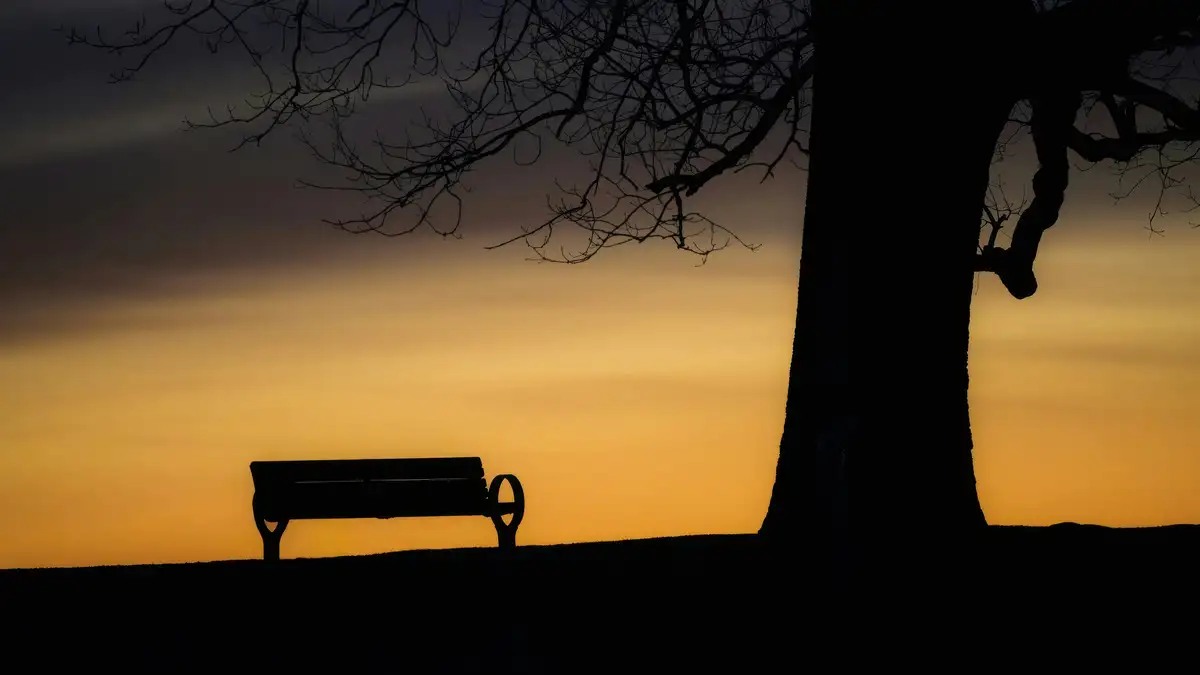
There's a bench in Paley Park on East 53rd Street in Manhattan that I've walked past maybe a hundred times without ever actually sitting down on it. It's one of those small vest-pocket parks the city tucked between skyscrapers in the 1960s, complete with a waterfall wall that drowns out the traffic noise and a handful of honey locust trees that turn gold in October. The bench is nothing special. Slatted wood, painted green, bolted to a low concrete pad. But at dusk, when the office workers have gone home and the tourists have moved on to dinner, it sits there in a kind of suspended stillness that I find almost unbearable to walk past without stopping.
I didn't stop. Not for years.
I'm not sure what I thought I was saving myself for.
The transition from day to evening in a city is one of those things that happens constantly and gets witnessed almost never. We're usually inside it rather than watching it, rushing through the amber light with our heads down, checking our phones, trying to catch the crosstown bus. The quality of the air changes. The shadows go long and then longer and then they simply merge into the general dimness, and the artificial lights start to seem less intrusive and more necessary, and somewhere in that shift something loosens. You feel it in your chest before you understand it with your mind.
The bench knows this. Or rather, the bench has been there for all of it, which amounts to almost the same thing.
What draws me to empty benches specifically, rather than occupied ones, is something I've been trying to put into words for a while. It's partly the sense of potential, the way an empty seat holds all the people who might sit in it. But it's also something simpler and less romantic than that. An empty bench at dusk is one of the only genuinely unclaimed spaces left in a modern city. No one is selling it to you. No one is asking you to consume anything. You can sit there and the city will simply... continue around you. The waterfall at Paley Park will keep going. The pigeons will do whatever pigeons do. The sky will do its slow impossible work of darkening.
That's rarer than it sounds.
I finally sat down on that bench in October of 2019, on a Tuesday, around 6:15 in the evening. I remember the date roughly because I'd just come from a meeting that had gone badly, the kind where you leave the building and stand on the sidewalk for a moment not quite sure which direction to walk. I turned east instead of west and ended up in the park almost by accident, and there was the bench, and there was the waterfall making its noise, and I sat down.
I stayed for forty-five minutes. I didn't take any photos. I didn't call anyone. I just sat there while the light changed and the park emptied out and the city rearranged itself around the arrival of evening.
It was, without question, one of the more useful forty-five minutes I've spent in New York.
There's a version of this essay that would want to romanticize the bench itself, to make it into a symbol of something. I'm going to try to resist that, because I think the bench is actually most interesting when you let it be ordinary. It's a piece of painted wood in a pocket park in Midtown. It isn't asking to mean anything. That's the whole point, actually (and honestly, that's the whole point) - the bench doesn't need you to have a breakthrough while you're sitting on it. It just needs you to sit.
What happens when you actually do that, when you surrender the forty-five minutes or the hour and simply occupy the bench as evening comes on, is that you start to notice the texture of time in a way that's usually invisible to you. The light doesn't change at a steady rate. It moves in small lurches, almost imperceptible, and then suddenly the park looks different and you can't say exactly when that happened. A pigeon lands near your feet and walks around purposefully and then flies away. A couple crosses the park holding hands without speaking. A woman in a yellow coat stops at the entrance, checks her phone, and leaves. None of this is remarkable. All of it is completely absorbing.
This is what I mean by the rhythm of overlooked urban life. It isn't the dramatic stuff, the protests and the accidents and the street performers. It's the incidental motion of people and light and small animals in a city that's always technically happening but almost never actually witnessed.
The bench has seen all of it.
I think about the weight of that sometimes, the sheer accumulated witnessing that a well-placed public bench represents. The one at Paley Park opened with the park in 1967. That's more than fifty years of dusks. More than fifty years of people sitting down with their grief or their lunch or their boredom or their tentative first-date conversations, and then getting up and walking away. The wood doesn't record any of it literally, obviously. But there's something about a surface that's been touched that many times that feels different from a new surface. Maybe that's just projection. Maybe it's something real about objects and use and time. I genuinely don't know.
In Siena, in the Piazza del Campo, there's a low stone ledge that runs around the inner edge of the piazza where people have been sitting since the medieval period. Not the same stone, obviously, the city has maintained and replaced it over the centuries. But the function has been continuous. The same ledge, the same purpose, the same angle of late afternoon light coming off the Palazzo Pubblico. When you sit there on a September evening and watch the piazza empty out after the tourists have gone for dinner, you're participating in something that has been happening in essentially the same way for an extremely long time. That doesn't make you special. It makes you momentarily part of something that's much bigger than you, which is different and, I'd argue, better.
The bench teaches this without trying to.
There's a particular quality of attention that dusk seems to require, or maybe just to reward. It's not the focused attention of someone trying to solve a problem or learn a skill. It's softer than that, more ambient. You're not looking at anything specifically, you're just... receiving. The light. The sound of the park settling. The smell of whatever the city smells like on that particular evening in that particular season. In late October in New York it smells like exhaust and fallen leaves and, if the wind is right, something almost cold and sweet that I've never been able to identify. I've tried. I've stopped and sniffed at things. I remain uncertain.
That kind of sensory uncertainty is actually one of the pleasures of sitting still at dusk. You notice things you can't quite explain, and because you're not in a hurry, you don't feel the need to immediately explain them. You just let them be unclear. This is harder than it sounds for most people, including me.
In the summer of 2022, I spent a week in Porto and made a habit of sitting on a particular bench in the Jardim de São Lázaro every evening around 7 o'clock. The garden is one of the oldest public parks in Portugal, opened in 1834, and in the evenings it fills with older men playing cards and young people on their phones and pigeons conducting their relentless negotiations with anyone who might have food. The bench I favored faced west, toward the jacaranda trees that were just finishing their bloom, and the light at that hour came through the leaves at an angle that turned everything slightly gold.
I'd been traveling alone, working, and the evenings in that garden were the only time all week when I wasn't trying to accomplish anything. I wasn't researching. I wasn't writing. I wasn't looking for something to eat or trying to navigate a new neighborhood. I was just sitting on a bench watching the light change, and it was one of those experiences that you know, even while it's happening, you're going to keep returning to in your memory.
The bench itself was nothing. Old wood, slightly uneven, with a plaque on one armrest that I could never quite read because the lettering had worn down. The garden was beautiful but not extraordinary. What made the evenings there feel significant was the act of stopping, of consenting to stillness in the middle of a week that was otherwise full of motion.
This is what travel rarely teaches you to do, by the way. Travel, especially the ambitious kind where you're trying to see everything and be everywhere, actively works against the kind of attention that a bench at dusk requires. You can be in Porto and miss Porto entirely because you're moving through it too fast. You can spend two hours at the Jardim de São Lázaro ticking it off a list without ever actually being there.
The bench is an invitation to actually be there. Whether you accept it is up to you.
I've been thinking about what it is that makes us resist sitting down. In cities especially, stillness feels like a kind of failure, a confession that you have nowhere to be. There's a social anxiety around public sitting that's distinct from other kinds of public behavior. No one feels embarrassed to walk fast through a park. But sitting alone on a bench at dusk, with no phone, with no food, just sitting... that still requires a small act of courage for most people, including people who'd laugh at the idea that it takes courage.
What are we afraid of? That someone will think we have nothing to do? That we'll have to be alone with our own thoughts for a few minutes? That the city will notice we've stopped moving and revoke our membership?
I don't know. I only know that the reluctance is real, and that getting past it is worth the effort.
Worth it. Every single time.
There's something else the empty bench offers that I don't think gets talked about enough, which is the experience of being a witness rather than a participant. When you're moving through a city you're always also performing, presenting your moving self to the people you pass, signaling your purpose and your direction through the way you walk and what you're wearing and whether you make eye contact. When you sit still, especially at the particular hour when the day-people have left and the night-people haven't quite arrived, you slip into a different register. You become part of the background. People stop performing for you. You get to see the city being itself rather than being seen.
This is one of the genuine gifts of the overlooked hours, the early morning before the cafes open, the late Sunday afternoon when the streets go quiet, and especially the dusk, that twenty or thirty minute window when the light is doing its most interesting work and nobody is quite sure whether they should turn on a lamp yet. The city exists in this window in a way it doesn't exist at noon or midnight. More honestly, maybe. Less curated.
The bench is there for all of it, patient in a way that I find genuinely consoling.
I want to be careful about overclaiming here. I'm not suggesting that sitting on a bench at dusk is a spiritual practice or that it will fix anything that's broken in your life. The meeting that went badly in October of 2019 was still bad when I got up from that bench in Paley Park. The things I was worried about were still there. But something had shifted slightly in how I was carrying them, in the ratio of problem to perspective, and that's not nothing. That's actually quite a lot.
There's a writer named Rebecca Solnit who has written beautifully about walking as a practice of thought, about the way that physical movement and mental movement echo each other. I think something similar is true of stillness, that sitting in a particular place at a particular time of day creates its own kind of internal movement, slower and less directed but no less real. The thoughts you have on a bench at dusk are different from the thoughts you have at a desk or in a meeting or on the subway. They're less efficient and less purposeful and, in my experience, more honest.
The light does something to your thinking. I'm convinced of this. The specific quality of evening light, that warm lowering amber that photographers call the golden hour, seems to create a corresponding quality of attention in whoever is sitting under it. You become more willing to let things be unresolved. More comfortable with not knowing. More able to look at something, a pigeon, a woman in a yellow coat, a waterfall, the sky going dark over the midtown rooflines, and just see it without immediately deciding what it means.
That's a skill. And like most skills, it gets easier with practice.
So here's what I'd suggest, and I'm aware this sounds almost embarrassingly simple: find a bench. Not a significant one, not a historic one with a plaque, just a bench in a park or a plaza or on a quiet street. Go there at dusk, around 6 o'clock in autumn or 7:30 in summer, whenever the light starts doing that thing it does. Sit down. Don't take a photo. Don't call anyone. Just sit there and watch what happens.
What will happen is mostly nothing, in the best sense. The light will change. People will pass. A bird will do something. The air will shift. And somewhere in the middle of all that gentle nothing, you'll feel the day release its grip on you a little, and you'll find yourself present in a way that's surprisingly hard to achieve by trying.
The bench in Paley Park is still there. It will be there this evening, when the office workers head home and the honey locusts go quiet and the waterfall keeps making its noise against the back wall. It will be empty for a while, that particular bench, or maybe someone will be sitting on it already, someone who figured this out before I did.
I hope they're not in a hurry. I hope they let the light do what it wants to do.
The city will go on around them. The evening will arrive, patient and unhurried, the way it always does. And for a little while, on a slatted wooden bench painted green, someone will be exactly where they are.
That's enough. That's genuinely enough.
Comments (0)
No comments yet. Be the first!